WMI
- Lorain, OH
WMI, the flagship station of Lorain
Electronics Corp. (LEC) or its predecessors, served the Great Lakes
bulk-carriers and freighters from the southern shore of Lake
Erie. Information about Lorain Electronics and its marine
radio stations in the Historical Collections of the Great Lakes at Bowling Green State University
indicates that WMI or some earlier Lorain station was operating by the
mid 1930s. The 1935 FCC Annual Report mentions Lorain, OH as
the location of one of only six public coastal harbor station operating
at that time. Other information pinpoints WMI's debut as
1933. This was probably only in the 2 MHz band, as the 1937
FCC Annual Report contains these words: "The Lorain (Ohio) station
operated by the Lorain County Radio Corporation, offers radiotelephone
service with ships plying the Great Lakes. During the year,
high-frequency operation has been inaugurated at this station."
WMI like WAY was operated by a telephone company, and was profesional in all respects. The photo below shows the large, and quite grand, WMI operating room in 1954.
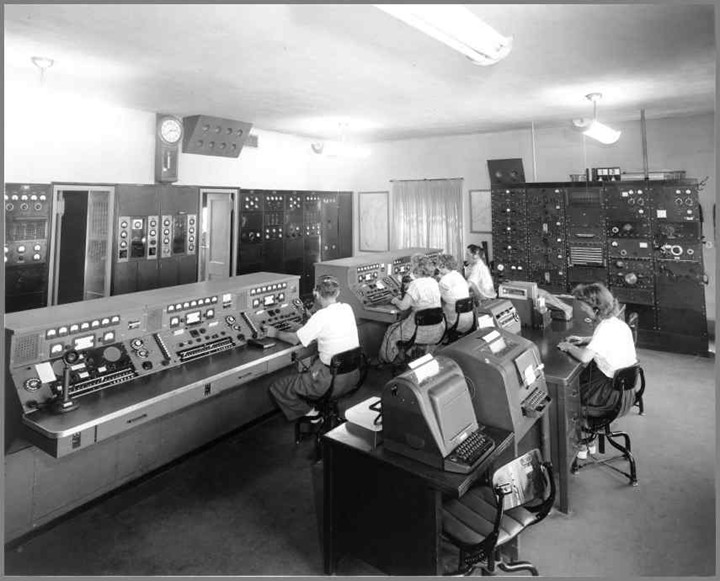
|
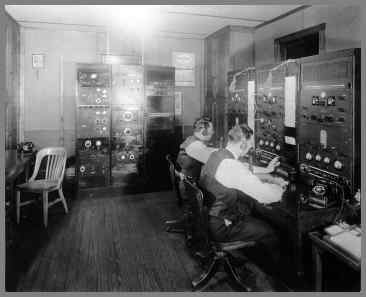
At
the left is the WMI operating room in Sept. of 1937. (Dated
from the calendar on the far wall.) Relatives report
that the man on the left is Don Heisner.
Some of the further evolution of
the WMI operating room can be seen in this series of
pictures. The dates are my best guesses and subject to
change.
1945
1948
1951
1954
1955
1958
In 1939 LEC
was also licensed to operated stations WAD in Port Washington, WI and
WAS in Duluth, MN.
I remember first hearing WMI as a teenager
with the operator saying, "This is Lorain." I though it
strange that she would give her name as an identifier.
However, I soon picked up the WMI call letters and figured out the Ohio
location. In reality, WMI was a spin-off of a telephone
company and as such was a highly disciplined operation. The
operators were not allowed to give out their names to either the ships
or the shipping companies. |
|
|
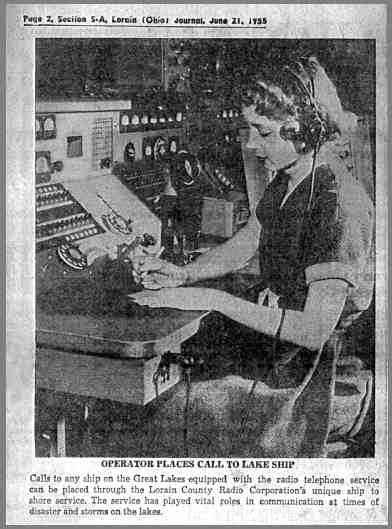
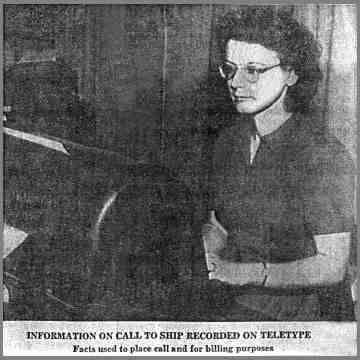 Two WMI operators at their positions in June of 1955. Photos from the June 21, 1955 Lorain (Ohio) Journal. The operator above, who furnished the photos, is Lura Krueck who spent 39 years employed by LEC. The operator on the right is Carol Auspsetter - ca. 1953.
Following is some Lorain Electronics/WMI history adapted from the Lorain Journal article noted above: |
 |
|
|
In the mid 1930s the idea to set up
ship-to-shore communications with the lake freighters was
born. Robert Fox was appointed chief engineer of the plant
and the wireless radiotelephone idea was begun. For a few years no more
than four lake ships had the radios as they covered only a short
distance. (Medium frequency only)
Once a ship was up in Lake Superior and the upper part of Lake Huron,
the Lorain station could not be heard.
The book "Master of The Inland Seas" by
Alexander C. Meakin, 1988, Great Lakes Historical Society, Vermilion,
Ohio 44089 makes the statement that the William C. Atwater was the
first Great Lakes ship to be equipped with a radio-telephone in
1934. However, see the WLC page as that honor really belongs
to the Carl D. Bradley (1922). In 1924, WLC reverted to
exclusively CW operation until 1941.
Fox, Don
Heisner, Company President Herman E. Hageman, and a few other men
worked out an idea for setting up high-frequency sets which would cover
the complete lake area from the Lorain station. After some
trouble with the sets, the Federal Communications Commission, and
nature, the service was inaugurated. Other lake freighters
soon wanted the new radiotelephone service and the corporation was on
its way. Per FCC action recorded December 19, 1934. The Loran
County Radio Corp., was granted construction permit (2 applications)
for portable equipment (Ohio), frequencies 2118, 2158, 2182, 2738 kc,
50 watts. Per FCC action recorded January 9,
1936. The Loran
County Radio Corp., Lorain, Ohio, was granted construction permit,
special experimental, located at WMI, 6,470, 11.370 kc. 400
watts.
The
October 1937 issue of All Wave Radio had this to say about WMI: WMI,
Lorain, Ohio, is used for ship-to-shore telephone service on the Great
Lakes. It operates on three talking circuits and service is given to
all points on the Great Lakes twenty-four hours per day. The
frequencies at the shore station are as follows: 2550, 6470 and 11370
kc. The corresponding circuits aboard ship are 2158, 6660 and 8820 kc.,
and also 13245 kc. on Lake Superior. The ship sets also have a
ship-to-shore frequency of 2738 kc. Address: WMI, The Lorain County
Radio Corporation, 203 Ninth Street, Lorain, Ohio.
This 1938
QSL card signed by D. Heisner was contributed by Mark
Karney. There is a 1968 WMI QSL card (and much more) on Ken Bobel's Recollection page .
The World Radio History's
magazine archive is the source of this article in
the September
1938 issue of the Radio News Magazine about WMI's beginnings.
Page 27
Page
57
The book mentioned above also states that:
(1) the Wilson Transit Company was the first fleet of Great
Lakes bulk carriers to be completely equipped with radio-telephones,
and also the first to be fully outfitted with VHF FM radios, and (2) in
1956 radio telephones and FM radio sets were installed in the few
remaining vessels in the fleet that were not equipped.
Heisner
succeeded Fox as chief engineer in the late 1930's, just as the large
expansion that followed the new high frequency service was getting
under way. Under his leadership the corporation founded new
stations (WAD in Port Washington, WI and WAS in Duluth, MN) along the
upper lakes.
Heisner left the corporation in 1946
and Wesley Goodell, a long time operator at the station, took over as
chief engineer. However, by the late 1960s an article (third on page) in the Lorain
Ohio Journal indicates that WMI was in financial trouble due to
declining use of the station. In the article Goodell is
quoted as saying that the main factor in the decline was the
corresponding decline in the number of ships on the lakes. "Right after
World II" Goodell said, "there were 400 vessels on the American side of
the lakes. That number has dwindled to about 200 now he says, "and
becomes fewer each year, as newer and larger ships replace older,
smaller ones." As the use of WMI's HF service declined
Goodell, LEC President Jack Cain (and
surely others also ??) conceived and implemented
the automated VHF-FM network that extended LEC's life by a number of
years. Details below and a more complete story here. Lorain engineers received
several patents for marine radio-telephone inventions including these:
2061699 2157234
2176868
Some
of the more significant dates of the corporation's history include 1934
and 1940 when it played vital parts In Lake storms and disasters, and
1938 when an FCC examiner finally approved the plan for HF AM
Ship-to-Shore radiotelephone communication. In 1951 the
corporation started VHF-FM phone service on the lakes, but ufortunately we don't know when WMI started SSB operation.
The Interlake Steamship Company's July
1958 Interlake Log has a four page article about WMI.
According to one correspondent:
"The AM channels at WMI were 51 (2182 KHz), 57, 58 (2 MHz
channels), 82 (4 MHz) and 96 (8 MHz)." These may have been at
a later time than those noted in the paragraph below.
The operator on the left above submitted
the following about WMI in the 1940s and 1950s: "WMI Lorain,
Ohio, WAD Port Washington, WI, and WAS Duluth, MN, communicated with
the vessels on AM Channels 10, 20, 30, 38, 39, 60 with Channel 51 being
the Calling and Distress frequency. WMI also
communicated with vessels on VHF-FM Channel 26 with Channel 16 being
the Calling and Distress frequency. Ships called in their
Position Reports to Station WMI, WAS, or WAD and these reports were
Dispatched via telephone, teletype, or Western Union to the various
Steamship Companies, Agents, or whomever the ship wanted to inform of
their ships business. A few vessels were equipped to send
Weather Reports - they would give the Station Radio-operator a series
of 5 or 6 groups of numbers (5 numbers in a group) and WMI, WAD, or WAS
would then forward this information to the Cleveland Weather Bureau.
The numbers provided information for the LAWEB Weather Bulletins that
were broadcast 4 times a day - 0230, 0630, l430, and 2030."
Mark Karney did some research at the
Lorain Library and found the two newspaper articles and three
photographs shown on this
page. Additional Journal articles have also been added to the page..
 |
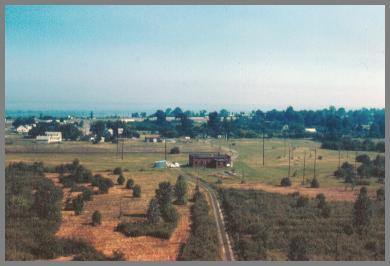 The WMI site in 1966 - Click
on the image
for 3 larger
views & more info. -
All photos by Mark Karney |
|
|
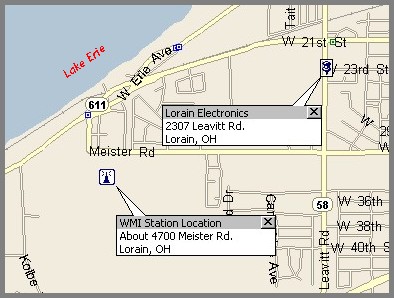
The map shows WMI's location
from its
founding until almost the end of its life. Also shown is the
LEC Leavitt Rd. location. The
Meister Road facility was decommissioned late in 1978 or early in 1979,
and remotely-controlled CAI SSB equipment was installed at a S0.
Amherst, Ohio site.
An operator position was installed at 2307 Leavitt Rd. The
VHF system (see below) was operated from there also. However,
MF/HF usage continued to decline and the SSB operation was discontinued
after a very short time and WMI's 47(?)
years of HF service to the lakers came to an end.
VHF-FM gained ground as the use of HF SSB
declined, and Lorain Electronics remained in the forefront starting
with the use of FM as early as 1952
(earlier?) utilizing General Electric
manufactured gear. May
of 1955 General Electric and Lorain County Radio sponsored a Great
Lakes cruise by the yacht, Cappy, to survey the coverage furnished by
Lorain's , GE supplied, 250 Watt station, located at Lorain.
The use of VHF-FM continued to expand culminating with a 14
station VHF network controlled from Lorain over leased lines.
It's unclear when this network went
into service. These stations provided excellent
coverage of all the lakes except Ontario. Here's
more detail on this
system and a map
showing the station locations, call letters, and channel
number.
In 1974 Lorain Electronics issued this VHF-FM frequency change bulletin to ship masters.
The VHF system was operated until 1984 when it was
sold to WJG Maritel. In 1985 the remaining contents of 2307
Leavitt Rd. were sold and Lorain Electronics closed it's
doors. Maritel operated the VHF system until 1990 and then
shut it down for lack of business. WLC picked up Several of
the VHF stations & used them until it shut down in 1997.
LEC also operated a Radio Common Carrier
(RCC) station serving businesses in the Lorain area with a mobile radio
connection to the telephone network. Initially at least, this
was a manual system with WMI operators connecting the calls.
I believe that the leftmost console position in the 1951 and later WMI
photos above was the control point for the RCC operation.
Former
LEC employee Ken Bobel has contributed much additional information
about LEC and WMI. Please see: Ken's Recollections
 |
 |
|
|
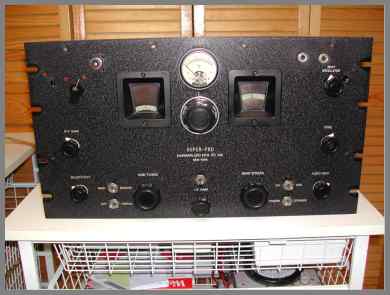
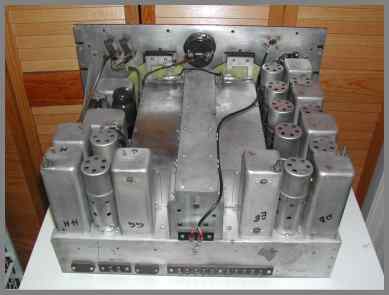
The Hammarlund SP-10 receiver
pictured
above was used at WMI, probably from the late 1930s through WW2 and
perhaps later??
This Rx is likely one of the three showing in the 1937 op
room
photo, and is probably the top unit (of 4) in left rack along the rear
wall in the 1948
Operating Room photo
as it is the only one that has an add-on connector in the upper
left corner of the front panel. When removed from service at
WMI
the receiver was purchased
by Carroll Peabody, W8ADK, (SK 2000) a service technician/service dispatcher with LEC. It was later purchased by Dave Aabye, W4QCU
who furnished the photos. Dave recently sold the receiver
to Henry Rogers W7HTR who removed all of the WMI modifications
and
completely restored it to its original "as delivered to WMI" condition.
You can see the restored version, other Hammarlund
receivers and company history on the Hammarlund page of
Henry's wonderful Western Historic Radio Museum web
site.
Some of the WMI
Crew and their recollections.
